- North East
- Arunachal Pradesh
- Assam
- Manipur
- Meghalaya
- Mizoram
- Nagaland
- Sikkim
- Tripura
Education in Manipur
Submitted by pbhagawati on Thu, 01/22/2009 - 13:44
|
Education is a life long process by which an individual acquires and accumulates knowledge, skills, attitudes and insights. It starts from the cradle and ends at the grave for an individual. And life experiences are given to child through the informal agencies like family, social groups (clubs, associations, political parties, literary circle, debating societies, library, mass media radio, television, cinema, museum, tour etc.) and also through the agencies of formal education such as schools, colleges, universities etc. However, education is one of the principal factors influencing the quality of the state’s labour force. It has an important role in the socio-economic development of the State. Its contribution to economic growth and its impact on population controls life expectancy, infant mortality, improving nutritional status and strengthening civil institutions is well recognised. As per National Policy on Education, priority has been accorded to the universalisation of primary education for children in the age group of 6 to 14 years.
Progress of Education:
There has been a great deal of accomplishment in the field of education since 1950-51. The number of educational institutions has increased from 538 in 1950-51 to over 4222 by the end of 2004-2005. Out of these 4222 institutions, 4089 were schools, 62 colleges and two universities. Following table shows the number of recognised educational institutions of various type and a comparative picture of the total number of recognised educational institutions in North-East States (2000) are presented in table below.
Number of Recognised Educational Institution by Types:
*Due to cancellation of non-formal education **Excluding professional and other education schools and colleges Source: Economic Survey Manipur, 2008-09
Since 1950-51, the number of institutions imparting occupational and technical education has shown a phenomenal increase. Among these, different types of institutions like those connected with agriculture, arts and commerce, engineering, medicine, physical education, teachers training etc. are emphatically included. The University level education is imparted in subjects such as arts, sciences, vocational courses and specialised subjects etc. Universities also offer good higher research facilities. It has been observed that significant progress had been made in the spheres of education in the state. The literacy rate in Manipur has gone up from 11 percent in 1951 to 70.5 percent in 2001. In the state, the rate of male literacy was as high as 80.3 percent while rate of the female literacy stood at 60.5 percent in 2001. Despite the rise in literacy rate, the absolute number of illiterates has increased due to fast growing population.
District wise Number of literates and illiterate persons and literacy rates of Manipur according to 2001 census:
Source: Economic Survey Manipur, 2008-09
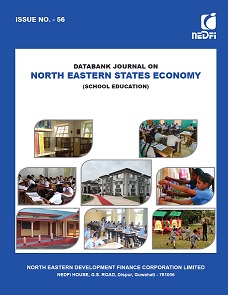
School Education:
As per the National Policy on Education 1986, a target had been set for the universalisation of primary education for children in the age group of 6 to 14 years. Under this policy, three aspects of elementary education viz. (i) universal access and enrolment (ii) universal retention of children upto 14 years of age and (iii) substantial improvement in the quality of education are to be achieved.
Several programmes like National Programme of Nutrition support to primary education (mid-day meal scheme) and promotion of girls’ education were also undertaken in the state. Under mid-day meal scheme, the state is providing 3kgs. of rice per student per month to the students of class I to V reading in 2997 Govt. and aided schools having primary classes. Under the scheme (Expanded Operation Black Board) of the Govt. of India, minimum teaching learning materials, like teachers equipment, teaching learning materials, games materials, play materials, books for library, furniture etc. were procured for 398 upper primary schools of the state. The total enrolment at the primary stage (Class I to V) increased from 213.19 thousands in 2001-02 to 355.35 thousands in 2002-03. Of these, the relative share of girls’ enrolment decreased from 48.78 percent in 2001-02 to 48.30 percent in 2002-03. Total enrolment at the middle/upper primary stage (Class VI to VIII) in 2002-03 is 124.59 thousands as against 151.45 thousands in 2001-02. The relative share of girls’ enrolment was 48.55 percent in 2002-03 as against 47 percent in 2001-02. Following table presents the number of students enrolled by stages.
Sex-wise Students enrolment by stage/classes:
Source: Economic Survey Manipur, 2008-09
The school level education is primarily looked after by the State Government. The high school stage of education comprising of classes from class IX to X are under the academic control of the Board of Secondary Education, Manipur. And Higher Secondary Schools Education comprising of class XI to XII comes under the control of Council of Higher Secondary Education, Manipur. The total number of high and higher secondary schools in the state were 706 by the end of 2004-05. The enrolment of students for high and higher secondary classes has decreased by 4.11 percent during 2002-03 over the previous year 2001-2002. And the average number of students per teacher in 2002-03 was 19 for high/higher secondary schools. The position about the number of high/higher secondary schools enrolment of students and the strength of teachers are presented in the following table which is given below.
Number of High/Higher Secondary School, students and teachers in Manipur:
Source: Economic Survey Manipur, 2008-09
Sarva Shiksha Abhiyan (SSA):
On 22nd June, 2004, an outlay of Rs. 4,601.13 lakhs was approved for implementation of SSA in Manipur. The objective of the SSA Project is to ensure universal education for children in the age group of 6-14 years. During 2004-05, the grant released by the Central and State Government was Rs. 17.25 crores and 3.68 crores respectively. Under the scheme, text book were provided to 2,34,299 girls and ST/SC children in class I-VIII in 2005-06. During 2006-07, 3,21,951 girls, ST/SC children in class I-VIII were given text books worth Rs. 150 per child. Again during the year 2007-08, free text books worth Rs. 3.96 crores have been provided to 2,76,120 students of ST/SC and all girls in the Government and Aided Schools of 68,159 school children are covered out of a total of 74,368 class I-VIII.
Higher Education/Colleges:
Higher education plays a crucial role in the national development process. The matters relating to higher education are looked after by Directorate of Higher Education (U). The total number of colleges for General Education in the state at the end of 2005 was 62 (all types including private colleges). All these colleges had teaching facilities for higher degree courses.
Number of Colleges, Students and Teachers for General Education of Manipur:
NA- Not Available * Excluding Private Colleges Source: Economic Survey Manipur, 2008-09
The above table shows an increasing trend in the number of colleges, students enrolment as well as in the number of teachers. The average number of students per teacher in 2000-01 was 15 for colleges.
Technical Education:
Technical education is basically meant to produce trained manpower in adequate numbers for speedy economic development of the state. Training have been diversified and programmes modified to take care of the needs of the modern development in technology. At the end of the Sixth Plan, the state had only a polytechnic having diploma courses in Civil, Electrical and Mechanical Engineering etc. But the existing arrangements for educating at degree level is by reserving specified number of seats in different Engineering Colleges of the country through the Ministry of Human Resource Development. One Engineering College (Govt. College of Technology) was started during the annual plan 1998-99 in 3 (three) courses viz., Civil, Computer Science, Electronic & Communication Engineering with per intake capacity of 30 (thirty) each further the produce of technically trained manpower for the upliftment of economic development of the state. Still, inspite of all these, progress of technical education is at a slow pace and the state is lagging behind and is quite below the level of the other states in the development of technical education.
Industrial Training Institute:
There are 7 (seven) Industrial Training Institutes in the state which are imparting various engineering and non-engineering training courses based on locally suitable selfemployment activities under two schemes viz., Craftsman training and Apprenticeship training. Under the aegis of the Government of India (DGET), training are also imparted in the new diversified fields so as to meet the technological advancement. During the Tenth Plan, 5 (five) Industrial Training Institutes are proposed to be set up at Imphal East, Thoubal, Bishnupur, Tamenglong and Chandel.
Non-Formal Education:
To achieve the goal of universalisation of elementary education and fulfillment of the constitutional objectives, Non-Formal Education (NFE) for the elementary age group children is being developed as an alternative supportive system of formal schooling. The State Council of Educational Research and Training (SCERT), has been working for the upliftment of the quality of education in the elementary stage of education as well as the goal of the universalisation of elementary education by adopting proper strategies non-formal educational schemes for drop-out and non-starters in the age group of 0-14. The SCERT has also been entrusted with the implementation of the schemes of vocationalisation of education at plus two stage for self-employment as one of the main objectives. This scheme is equally shared by Central and State Governments. It is basically aimed at providing the institutional infrastructure necessary both for coverage of non-enrolled and non-attending children and strengthening the academic inputs of the action programme of non- formal education. During the Ninth Plan period, 3122 non-formal education centres have been functioning through 55 NFE projects with the total enrolment of 90,000 learners all over the state. Under the vocationalisation of education 8 schools were covered and 3 booklets were published. The proposed outlay for the Tenth Five Year Plan (2002-07) is Rs.900.00 lakhs of which a sum of Rs.200.00 lakhs is proposed for the Annual Plan (2002-03).
Adult Education:
The “National Literacy Mission” (NLM) was established in 1988 by the Government of India with the aim of successful implementation of strategies of eradicating illiteracy in the age group of 15 to 35 years. Following prescribed detailed guidelines for the implementation of total literacy campaign, the state Government has taken a policy decision to implement Total Literacy Campaign (TLC) in a phase manner. During the Ninth Plan (1997-2002) it was targetted to eradicate 2.12 lakhs illiterate population in the age group of 15 to 35 years and retention of literacy skills for the new literates by the introduction of complete course of the programmes of Basic Literacy and post literacy followed by continuing Education Programme in phases through Jana Shikshan Nitayamas (JSN) centres. Out of this 2.12 lakhs population, 1.92 lakhs are to be covered under centre based projects and the remaining 0.20 lakhs population are to be taken care of by the Post-Literacy and continuing phasewise education programmes through JSN centres. It is proposed to eradicate 1,92,914 (87,257 males & 1,05,657 females) illiterate populations in the age group of 15 to 35 years during the Tenth plan (2002-2007). It also aim at the retention of literacy skills as well as improvement of skill of the neo- literates.
A State Literacy Mission Authority (SLMA), Manipur was constituted as per the directive given by the NLM Authority, Government of India. In 2004-05, the TLC was launched is all the nine (9) districts of Manipur, through the District Literacy Societies (DLSs). The project is funded on sharing basis by the Government of India and the State Government in the ratio of 2:1 and 4:1 is respect of the Valley and Hill districts respectively. There are three literacy phases in the TLC programme. In each phase, a primer/book need to be completed by adult learners. The teacher are volunteers mostly educated unemployed youths, club members, women societies members, church members, retired teachers etc. The districtwise physical achievement of the TLC as on March 2007 is shown in table below.
Physical achievement of TLC as on March, 2007:(in nos.)
Source: Economic Survey Manipur, 2008-09
Post Literacy Programme (PLP):
The PLP was launched in Manipur during 2006-07 with the following objectives: (i) Remedy the deficiency of learning in the literacy phases or, in other woods, build up literacy skills satisfactory standards; (ii) Retention, re-enforcement, stabilization and upgrading of literacy skills and improvement of functional skills; (iii) Application in living and working situations but this need to be encouraged by positive measure. Through application of literacy, people begin to participate in the development process.
The programme is funded by the Central and State Government in the ratio of 2:1 and 4:1 in the Valley and Hill districts respectively. The target groups of the programme are :-
(i) Drop outs of TLC, (ii) Uncovered (gap between figures of TLC survey and enrolment), (iii) Neo-literates and (iv) New entrants/school drop out who are in the age group of 15 years and above.
The physical achievement of post literacy programme as on December, 2007 is given below :-
Physical achievement of PLP as on December, 2007:
Source: Economic Survey Manipur, 2008-09
|
|||||||||||||||||||||||||||||||||||||||||||||||||||||||||||||||||||||||||||||||||||||||||||||||||||||||||||||||||||||||||||||||||||||||||||||||||||||||||||||||||||||||||||||||||||||||||||||||||||||||||||||||||||||||||||||||||||||||||||||||||||||||||||||||||||||||||||||||||||||||||||||||||||||||||||||||||||||||||||||||||||||||||||||||||||||||||||||||||||||||||||||||||||||||||||||||||||||||||||||||||||||||||||||||||||||||||||||||||||||||||||||||||||||||||||||||||||||||||||||||||||||||||||||||||||||||||||||||||||||||||||||||||||||||||||||||||||||||||||||||||||||||||||||||||||||||||||||||||||||||||||||||||||||||||||||||||||||||||||||||||||||||||||||||||||||||||||||||||||